Gorilla Trekking Safaris in Volcanoes Rwanda - Rwanda Safaris. A gorilla trekking safari to Volcanoes National Park in Rwanda is the most celebrated wildlife experience in Africa — a journey into the ancient montane forest of the Virunga volcanic chain to spend one extraordinary hour with a habituated mountain gorilla family in the wild. Rwanda's gorilla trekking safari programme, managed with meticulous care by the Rwanda Development Board, is the most refined, most accessible, and most consistently rewarding gorilla safari experience in the world — and at Kenlink Tours, designing Rwanda gorilla trekking safaris is one of the things we do best.
Volcanoes National Park — Parc National des Volcans in French — sits in the far northwest of Rwanda, its forest covering the lower slopes of eight Virunga volcanoes shared between Rwanda, Uganda, and the Democratic Republic of Congo. It is within this ancient montane forest, draped across the volcanic flanks of Karisimbi, Bisoke, Muhabura, Gahinga, and Sabyinyo, that Rwanda's twelve habituated mountain gorilla families live out their days — ranging through bamboo forest and hagenia woodland, through open afro-alpine meadows and vine-tangled valley floors, in complete and magnificent indifference to the world beyond their terrain. The gorilla trekking safari exists at their convenience, not ours. That is precisely what makes it so extraordinary. Our comprehensive guide to gorilla safari holidays covers the full East Africa gorilla landscape, and our detailed guide on landing in Kigali for a gorilla safari helps you understand how Rwanda fits into a broader East Africa itinerary.
Volcanoes National Park — The Landscape and Its History
Volcanoes National Park covers 160 square kilometres of protected montane forest in the Virunga Massif — a volcanic chain of eight volcanoes straddling the borders of Rwanda, Uganda, and the DRC that forms one of the most geologically dramatic and biologically significant landscapes in Africa. The park was first established as the Albert National Park in 1925 — the oldest national park in Africa — and its history is inseparable from the history of mountain gorilla conservation itself.
It was in the forests above Volcanoes National Park's Kinigi headquarters that the American primatologist Dian Fossey established the Karisoke Research Centre in 1967 — beginning eighteen years of continuous gorilla research that produced the scientific and conservation foundation on which all modern gorilla trekking programmes are built. Fossey's work, and her death in 1985 in circumstances still disputed, transformed the world's understanding of mountain gorilla behaviour and catalysed the conservation movement that saved the species from extinction. Her grave, marked by a simple headstone among the gorillas she protected, sits on the forested slopes of Mount Visoke and is visited as part of the Karisoke hike available to gorilla trekkers in the park. The Gorilla Doctors organisation, which provides ongoing veterinary monitoring and medical intervention for the habituated gorilla families of Volcanoes National Park, operates partly from the legacy of research infrastructure that Fossey's programme established.
The mountain gorilla recovery — a conservation milestone
When Dian Fossey began her research in the Virunga Massif in the 1960s, the mountain gorilla population had declined to fewer than 250 individuals. Today, the combined Virunga-Bwindi population exceeds 1,000 — the only great ape subspecies whose wild population is currently increasing. The IUCN Red List reclassified the mountain gorilla from Critically Endangered to Endangered in 2018, citing the population increase as a direct result of the conservation and managed tourism programmes in Rwanda, Uganda, and the DRC. Every gorilla trekking permit purchased in Volcanoes National Park funds the ranger patrols, veterinary monitoring, and community benefit programmes that have driven this recovery. Rwanda's gorilla trekking safari is not just a wildlife encounter — it is an act of conservation participation in one of the great success stories of modern wildlife management.
The Twelve Gorilla Families of Volcanoes National Park
Rwanda currently has twelve fully habituated gorilla families open to trekking visitors in Volcanoes National Park — the highest number of trekking-accessible gorilla families of any country in the world. Each family has its own territory, personality, and ranging pattern. The Rwanda Development Board assigns trekking groups to families each morning at the Kinigi briefing, based on the tracking report from rangers who locate each family at dawn. Below are the main gorilla families of Volcanoes National Park with notes on their character, range, and typical trek difficulty.
| Family Name | Character & Notes | Typical Elevation Range | Trek Difficulty |
|---|---|---|---|
| Susa A | The most historically significant gorilla family in Rwanda — the group originally studied by Dian Fossey at the Karisoke Research Centre. A large, celebrated family whose encounters often take place at higher elevations on the Karisimbi and Visoke slopes. Known for producing a celebrated set of twins, which is extremely rare among mountain gorillas. The trek to Susa A is among the longest and most demanding in the park but among the most rewarding. | High — upper Karisimbi and Visoke slopes | Challenging |
| Susa B (Karisimbi) | Formed after a split from the original Susa group, Susa B — also known as the Karisimbi group — ranges on the upper Karisimbi slopes. One of the higher-altitude families in the park, with treks that can involve significant elevation gain. A strong choice for physically fit trekkers who want the upper volcanic forest experience. | High — Karisimbi upper slopes | Challenging |
| Amahoro | "Peaceful" in Kinyarwanda. The Amahoro family consistently delivers one of the most relaxed and photogenic gorilla encounters in the park — a calm, well-habituated family that moves through the mid-altitude forest below Bisoke in a settled and unhurried way. Frequently cited as the best family for first-time trekkers and photography-focused visitors. One of the most sought-after family assignments at the morning briefing. | Mid — Bisoke lower and mid slopes | Moderate |
| Umubano | A large, well-established family with a commanding silverback and a settled social hierarchy. Umubano ranges through accessible forest terrain on the lower Bisoke and Sabyinyo slopes, making it one of the most reliably encountered families for treks of moderate duration. A strong recommendation for first-time trekkers with average fitness levels. | Low to mid — Bisoke and Sabyinyo lower slopes | Moderate |
| Kwitonda | "The humble one" — a large family that migrated into Rwanda from the DRC and was habituated in Volcanoes National Park. A particularly rich social encounter due to the family's large size and active dynamic. Kwitonda ranges widely across the Sabyinyo slopes, giving treks that can vary significantly in duration and elevation. Good for experienced trekkers. | Variable — Sabyinyo slopes | Moderate to Challenging |
| Hirwa | "The lucky one" — a uniquely constituted family that formed through the merging of members from multiple other groups and has produced an unusually high number of twins over its history. Hirwa ranges through the lower Sabyinyo and Gahinga slopes, in habitat that overlaps with the golden monkey bamboo zones, making it possible to combine a Hirwa gorilla trek with golden monkey tracking in the same area on the same day. | Low — Sabyinyo and Gahinga lower slopes | Easy to Moderate |
| Agashya / Group 13 | One of the most accessible families in the park — Group 13 ranges on the lowest forested slopes closest to the park boundary, consistently delivering some of the shortest trek durations in Volcanoes National Park. An excellent choice for older travellers, those with fitness concerns, families trekking with younger permitted participants (minimum age 15), and anyone who wants the full gorilla encounter without the additional physical demand of higher-altitude families. | Low — lower park boundary slopes | Easy to Moderate |
| Sabyinyo | A settled, well-habituated family ranging on the slopes of Sabyinyo volcano. Known for calm, extended encounters with good photographic opportunities. The Sabyinyo slopes offer a particularly beautiful forest environment with large hagenia trees and an open canopy that allows better light penetration than some of the denser valley forest sections. | Low to mid — Sabyinyo slopes | Easy to Moderate |
| Muhoza | A newer fully habituated family that has expanded the park's trekking capacity and now offers a reliable additional permit option, particularly useful for peak-season bookings when the more established families are in highest demand. Contact our Kenlink Tours bookings team for the most current status and availability. | Variable | Moderate |
| Igisha | A recently fully habituated family adding important trekking flexibility to the Volcanoes NP programme. Ranging across the forest zones of the mid-park sector, Igisha offers encounters of good quality and typical duration. Valuable for permit allocation in high-demand periods. | Mid — central park sector | Moderate |
| Isimbi | One of the more recently habituated families, Isimbi contributes to the expanding trekking portfolio of Volcanoes National Park and is now available for permit allocation as part of the park's twelve-family programme. Ask our team about current ranging patterns and encounter history for the most up-to-date picture. | Variable | Moderate |
| Kinigi | Named for the park's headquarters village, the Kinigi family is one of the lower-ranging habituated groups in Volcanoes National Park — accessible terrain and relatively short trek durations make it another strong option for first-time trekkers and those with limited time. Combined with the gateway location of Kinigi headquarters, encounters with this family can be among the most efficiently structured in the park. | Low — Kinigi sector lower forest | Easy to Moderate |
Family assignment on trek day: The Rwanda Development Board assigns all trekking groups to gorilla families at the 7:00 AM briefing at Kinigi headquarters, based on that morning's tracking report. Trekkers cannot pre-select a specific family — assignment is made by the RDB rangers based on family location, group fitness level, and permit allocation. Our Kenlink Tours bookings team can communicate your fitness level and preferences to the RDB team in advance, and we will advocate for the most appropriate assignment for your group. For first-time trekkers, we typically recommend indicating a preference for mid-elevation families such as Amahoro, Umubano, or Agashya.
The Gorilla Trek Day — A Complete Account
For travellers who have never trekked gorillas before, understanding the structure of a Rwanda gorilla trek day in full detail helps remove anxiety and ensures you arrive at Kinigi prepared, properly equipped, and ready to be fully present for the experience ahead. The sequence below reflects what every gorilla trekker experiences in Volcanoes National Park.
AM
Early Morning at Your Lodge
Wake before sunrise. Your lodge will serve an early breakfast from around 5:30–6:00 AM — eat well, as the trek can run from forty minutes to five or more hours depending on where the gorilla family has ranged overnight. Dress in your trek clothing: long trousers, long-sleeved shirt, sturdy hiking boots with ankle support, and gaiters if you have them. Pack your day bag: at minimum two litres of water, your packed lunch (the lodge prepares this), rain jacket, camera, and any personal medication. Neutral colours only — no bright clothes or white garments in the forest. Transfer to Kinigi park headquarters by 6:45 AM.
AM
Kinigi Park Headquarters — RDB Briefing
All trekking groups assemble at the Kinigi visitor centre for the morning briefing at 7:00 AM sharp. The Rwanda Development Board ranger team presents the tracking report from the rangers who located each gorilla family at dawn, confirms group assignments to families, and delivers the full trekking orientation — rules of the encounter (seven-metre minimum distance, no flash photography, masks required within seven metres, no eating or drinking near the gorillas, no touching), health precautions, emergency procedures, and photography guidance. The briefing lasts approximately twenty to thirty minutes. This is also where you meet your designated RDB armed ranger escort and your personal porter if you have arranged one. The morning atmosphere at Kinigi — a gathering of trekking groups from around the world, all about to enter the same forest — is one of the quietly memorable parts of a Rwanda gorilla safari.
AM
The Trek to the Gorilla Family
Groups depart Kinigi and drive a short distance to their designated trailhead — the starting point varies by family and can range from the forest edge near the park boundary to a longer vehicle approach toward the upper sector. The trek begins at the park boundary fence, where the farmland of the Kinigi valley gives way to the ancient montane forest of the Virunga slopes. The forest changes character as you ascend — bamboo zones in the lower sections give way to dense hagenia and hypericum woodland higher up, and the calls of Albertine Rift endemic birds accompany the walk throughout. The pace is always set by the ranger guide to be sustainable for all fitness levels — no one is left behind, and porters carry the physical load for those who want support. The trek to the gorilla family involves following the rangers' radio contact with the tracking team, adjusting direction as the family's current position is updated in real time. When the lead ranger stops and signals, the family is close.
One Hour with the Mountain Gorillas
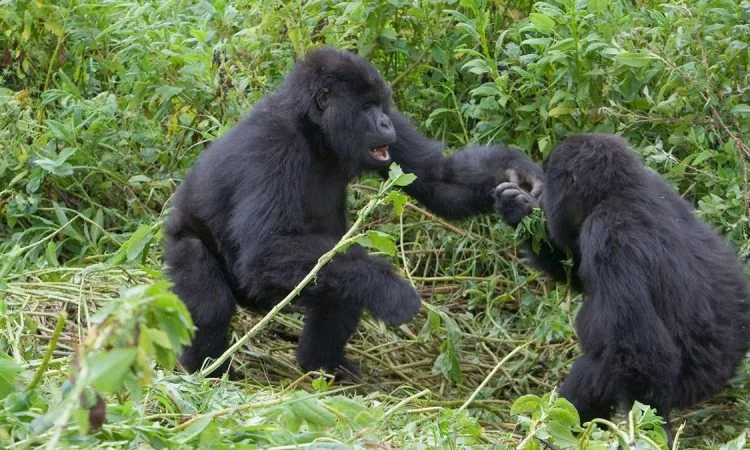
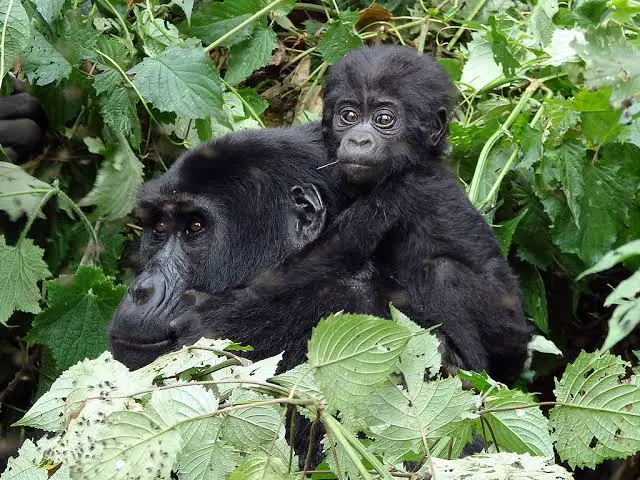
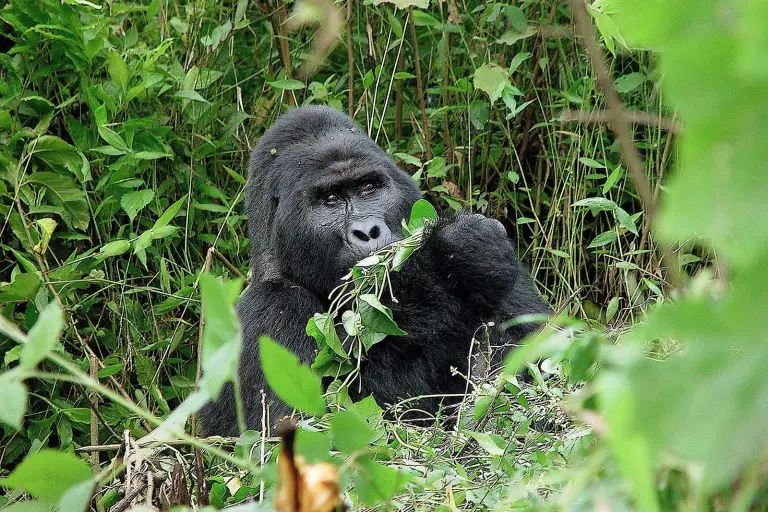
Contact. The ranger crouches, the group stops, and the forest opens onto the gorilla family going about their morning — feeding, resting, playing, socialising. The one-hour encounter begins the moment a member of your group makes visual contact with the first gorilla. The hour is timed precisely by the lead ranger and is a strict conservation regulation — more time than this, across multiple daily groups, would risk habituating the families too deeply and exposing them to accumulated health risk from human proximity. Within that hour, you may watch a silverback's massive, unhurried bulk settle against a tree trunk and close his eyes. You may see juveniles chasing each other through the canopy branches with an energy and recklessness that is immediately recognisable. You may find yourself within three metres of a young blackback who has wandered curiously toward your group and been called back by his mother. The encounter is always different. It is never less than extraordinary. The timer ends, the ranger signals the retreat, and the group withdraws from the family's range — leaving them entirely undisturbed to continue their day in the ancient forest of the Virunga Massif.
Certificate, Return & Celebration
The return hike to the forest boundary, then to the vehicle, then back to Kinigi — a journey that most trekkers make in a state of quiet exhilaration. At Kinigi, the RDB issues every permit holder a personalised gorilla trekking certificate — a formal record of the family encountered, the date, and your name, printed and ready for collection at the visitor centre. Transfer back to your lodge for a celebratory lunch. Most trekkers spend the afternoon resting and processing the experience, reviewing photographs, and beginning the process of deciding how to describe it to everyone who was not there. The afternoon is yours.
Rwanda Gorilla Safari Packages
Every Rwanda gorilla trekking safari we design at Kenlink Tours is built around the same structural principle: protect the trek day above everything else, maximise the quality of every other day around it, and ensure the overall itinerary is coherent enough that it tells a complete Rwanda story rather than simply stringing activities together. The packages below represent our most frequently booked Rwanda gorilla safari structures. All include the Rwanda gorilla permit (USD $1,500 per person), all accommodation at the stated category, all park fees, all transfers, and a professional Kenlink Tours guide. International flights are not included.
The Rwanda Gorilla Express — 3 Days
Kigali · Volcanoes NP · KigaliThe most focused Rwanda gorilla safari — one night in Kigali, transfer to the Volcanoes sector, gorilla trek, return to Kigali. Ideal for business travellers with a Kigali connection, short-break visitors, or anyone for whom the gorilla encounter is the sole purpose of the Rwanda visit. The three-day structure is tight but never rushed — the lodge night before the trek protects the trek morning from any travel fatigue, and the return to Kigali after the encounter is unhurried.
Gorillas & Golden Monkeys — 4 Days
Kigali · Volcanoes NP · KigaliThe most popular Rwanda gorilla safari — pairing the mountain gorilla encounter with golden monkey tracking in the lower bamboo zones of Volcanoes National Park. The golden monkey (Cercopithecus kandti) is endemic to the Albertine Rift and found only in the Virunga-Bwindi landscape. Its tracking experience — through dense bamboo forest, following a loud, fast-moving troop of vividly coloured primates — is a joyful and visually spectacular counterpart to the gravitas of the gorilla encounter. This four-day format gives both experiences sufficient space without overpacking the schedule.
Gorillas, Fossey & Kigali Culture — 5 Days
Kigali · Volcanoes NP · KigaliThe complete introduction to Rwanda — gorilla trekking and golden monkey tracking in Volcanoes National Park, the Dian Fossey grave hike to the Karisoke Research Centre on the slopes of Mount Visoke, and a full Kigali cultural programme. This is the most frequently recommended itinerary for first-time Rwanda visitors who want to understand the country beyond its headline wildlife experience. The Fossey hike is a three-hour forest walk to one of conservation history's most significant sites — and completing it on the day after a gorilla trek, when the forest and the families are still fresh in your experience, makes the hike uniquely resonant. The Kigali day adds the cultural and historical depth that transforms a wildlife trip into a Rwanda experience.
Rwanda Complete — Gorillas, Big Five & Culture — 7 Days
Kigali · Volcanoes NP · Akagera NP · KigaliThe definitive Rwanda safari — seven days that combine gorilla trekking and golden monkey tracking in Volcanoes National Park in the northwest with two nights of Big Five game drives and a boat safari in Akagera National Park in the east, framed by a full Kigali cultural day. This itinerary covers the complete range of Rwanda's wildlife and cultural offering within a tight and coherent route: northwest for the forest and primates, central for the culture, east for the savannah. Two completely different national parks, two completely different ecosystems, and the richest possible introduction to what Rwanda offers within a single week. Our Uganda–Rwanda connecting safari page shows how this itinerary can be extended into Uganda for a ten-day East Africa circuit.
Rwanda & Uganda Gorilla Double — 10 Days
Kigali · Volcanoes NP · Bwindi · EntebbeThe great East Africa gorilla circuit — two gorilla encounters in two countries, two national parks, and two landscapes, beginning in Kigali and ending in Entebbe. Gorilla trekking in Volcanoes National Park (Rwanda), then crossing the Cyanika border to gorilla trekking in Bwindi Impenetrable National Park (Uganda). Rwanda's volcanic montane forest and Uganda's ancient equatorial rainforest — the Virunga and the Bwindi — are the two sides of the same mountain gorilla story, and experiencing both in a single itinerary gives a depth of understanding that neither alone can provide. This package includes both the Rwanda permit (USD $1,500) and the Uganda permit (USD $800), and can be extended to include Queen Elizabeth National Park, Kibale chimpanzees, or the tree climbing lions of Ishasha. Our full guide to combining Rwanda and Uganda gorilla trekking covers every aspect of this cross-border itinerary.
Best Time for a Volcanoes National Park Gorilla Safari
Volcanoes National Park's gorilla families are present and trekking is available year-round — the RDB issues permits in every month of the year, and the gorillas do not have a season. What changes seasonally is the conditions underfoot, the forest light, the lodge rates, and the permit competition. Understanding the seasonal rhythm helps you choose the visit window that best suits your priorities.
June – August — Long Dry Season
Peak Season · Best ConditionsDec – February — Short Dry Season
Shoulder Peak · Excellent ValueSept – November — Short Rains
Green Season · Fewer VisitorsMarch – May — Long Rains
Low Season · Best Lodge RatesWhere to Stay — Lodges Near Volcanoes National Park
Bisate Lodge — Ultra Luxury
The finest gorilla trekking lodge in Africa — six private forest villas built into an eroded volcanic cone with 270-degree Virunga views and an on-site reforestation programme. All-inclusive, fully private, and utterly irreplaceable. Available on our luxury Rwanda gorilla safari packages. Book twelve months ahead for peak season.
One&Only Gorilla's Nest — Luxury
Sixteen private forest lodges in a private reserve bordering Volcanoes National Park. Full spa, pool, and the complete One&Only service standard — the most resort-complete luxury experience in the Volcanoes sector. Ideal for honeymoons, milestone trips, and travellers for whom the lodge is as important as the trek.
Sabyinyo Silverback Lodge — Luxury
Eight stone cottages managed in partnership with the local Gorilla Organisation community trust. Outstanding Virunga views, exceptional food, and a direct ethical contribution to the communities surrounding the park. One of the strongest conservation-focused luxury choices in the Volcanoes sector and available on our gorilla safari packages.
Mid-Range Musanze Options
Comfortable, clean, and well-managed mid-range guesthouses and hotels in and around Musanze town offer excellent value for gorilla safari travellers whose budget is focused on the permit rather than the accommodation. Our budget safari guide covers the best affordable options and our bookings team can match the right lodge to your budget and dates.
Rwanda vs Uganda — Choosing Your Gorilla Destination
| Criteria | Rwanda (Volcanoes NP) | Uganda (Bwindi / Mgahinga) |
|---|---|---|
| Gorilla permit cost | USD $1,500 | USD $800 |
| Airport to park transfer | 2–3 hrs from Kigali | 8–10 hrs from Entebbe |
| Habituated families | 12 families | 20+ families (Bwindi + Mgahinga) |
| Gorilla habituation experience | ✕ Not available | ✓ Rushaga sector — 4 hrs with gorillas |
| Luxury lodge quality | World-class — highest concentration anywhere | Excellent — strong options in all sectors |
| Landscape character | Volcanic peaks, open montane forest | Ancient equatorial rainforest, varied terrain |
| Additional wildlife circuit | Akagera Big Five, Nyungwe primates | QENP lions, Kibale chimps, Murchison Falls |
| Combined Rwanda + Uganda possible | ✓ Via Cyanika border (2–3 hrs) | ✓ Via Cyanika border (2–3 hrs) |
| Best for short trips (3–4 days) | ✓ Excellent | ✕ Transfer distance makes short trips harder |
Essential Tips for Your Rwanda Gorilla Trekking Safari
-
1Secure your permit at least six months before your trek date — The Rwanda gorilla permit at USD $1,500 is issued by the Rwanda Development Board in limited quantities — eight trekkers per family per day, twelve families, maximum 96 permits per day across the park. For peak season (June–August and December–January), permits for the most desirable families sell out many months in advance. Our Kenlink Tours bookings team manages all Rwanda permit procurement on behalf of clients and can advise on current availability for any target date.
-
2Always arrive at your lodge the night before the trek — The RDB morning briefing at Kinigi begins at 7:00 AM. Attempting the two-to-three-hour drive from Kigali on the same morning requires a pre-dawn departure and guarantees arriving tired. Always include a lodge night in the Volcanoes sector before your trek day — this single structural decision makes a greater difference to the quality of your gorilla safari experience than almost any other factor. For more detail on short Rwanda gorilla safari logistics, read our full gorilla safari guide.
-
3Hire a porter at Kinigi — always — Official RDB porters are available at the Kinigi briefing point for a modest fee, and their value is enormous. On any trek to a higher-ranging family, having a porter carry your day pack while you focus entirely on the forest and the moment of encounter transforms the physical experience. Porter fees also provide direct income to families in communities adjacent to the park — this is both practical support and conservation participation. The African Parks Network, which models community benefit across its managed parks, recognises the Volcanoes porter programme as a strong example of conservation-linked livelihoods.
-
4Wear a mask during the gorilla encounter — it is mandatory — Mountain gorillas share approximately 98% of human DNA and are highly susceptible to human respiratory viruses. The RDB requires all trekkers to wear a surgical or cloth mask within seven metres of the gorilla family at all times — this is a non-negotiable health protection measure. Your lodge or the Kinigi briefing centre can provide masks if you do not bring your own. Do not trek if you are experiencing any respiratory symptoms — inform your guide and the RDB team, who will arrange a permit postponement.
-
5Pack a rain jacket and gaiters regardless of season — The Virunga montane forest generates its own weather, and brief showers are possible even during the dry season on the upper volcanic slopes. Gaiters protect against nettles and mud on the lower forest sections, and a quality waterproof shell is as important on a dry-season trek as on a wet-season one. Bring both, use both, and leave your non-trek luggage at the lodge.
-
6Consider extending into Uganda for a double gorilla experience — The Cyanika border between Musanze (Rwanda) and Kisoro (Uganda) is just two to three hours from the Volcanoes sector, making a Rwanda–Uganda gorilla double one of the most efficiently structured two-country safari combinations available anywhere in East Africa. Our detailed guide to combining Rwanda and Uganda gorilla trekking explains the routing, the logistics, and the profound difference between the Virunga and Bwindi gorilla experiences that makes the combination so rewarding.
A gorilla trekking safari to Volcanoes National Park is not simply one of Africa's great wildlife experiences — it is one of the defining encounters available anywhere in the natural world. The mountain gorilla population has survived against extraordinary odds, and its recovery is a story of what is possible when conservation resources, community benefit, scientific rigour, and managed tourism are aligned toward a single goal. The IUCN reclassification of mountain gorillas from Critically Endangered to Endangered in 2018 was a milestone that owed more to Rwanda's gorilla trekking programme than to any other single factor. When you purchase a Rwanda gorilla permit and enter Volcanoes National Park with your ranger guide, you are part of the system that made that milestone possible — and the system that will determine whether the mountain gorilla's recovery continues for another generation.
To begin planning your Rwanda gorilla trekking safari in Volcanoes National Park, contact the Kenlink Tours team today. Browse our Rwanda safari deals, read our cost guide on how much a gorilla safari costs, and explore our safari package selection guide for Uganda and Rwanda. Whether you are planning a focused three-day gorilla express, a complete seven-day Rwanda safari, or the full East Africa gorilla circuit from Kigali to Entebbe, our team will design an itinerary that makes every hour in the Virunga forest count.