- EXPERT'S HELP
- +256789210067
- +256200955001
- info@kenlinktours.com


Best Honeymoon Safari Destinations in Uganda
May 7, 2026
Safari Activities Around Queen Elizabeth National Park
May 7, 2026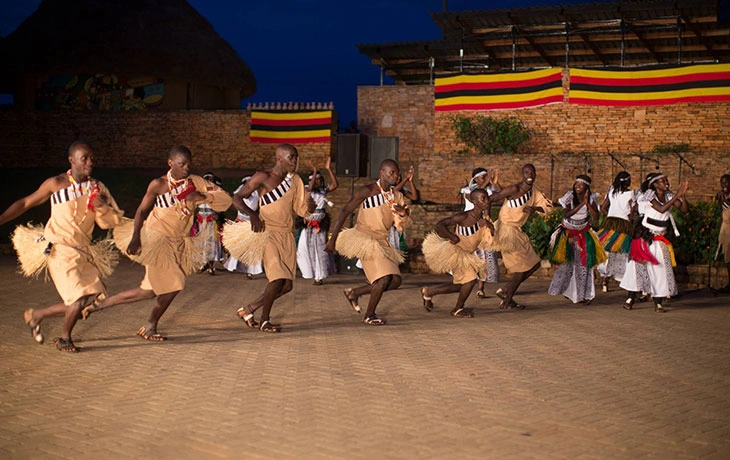
Cultural Experiences to Add to Your Uganda Safari. Uganda’s wildlife is extraordinary. Mountain gorillas in ancient forest, tree-climbing lions at dusk, the Nile bursting through a narrow gorge, a thousand birds filling a papyrus swamp — these are the experiences that draw most international visitors to the Pearl of Africa. But Uganda holds another dimension of depth that many safari itineraries touch too briefly or skip entirely: its people and cultures. With over 56 distinct ethnic groups — each with its own language, traditional kingdom, ceremonies, music, art, and relationship with the land — Uganda is as culturally rich as it is biologically diverse. The two are not separate stories. They are the same story, told from different angles. This guide explores the most compelling cultural experiences to weave into your Uganda safari, and why doing so will make your entire journey more meaningful, more connected, and more complete.
Why Culture Belongs on Every Uganda Safari
Most travellers arrive in Uganda focused exclusively on wildlife — the gorilla permit is booked, the national park circuit is mapped, the camera is loaded. And then something unexpected happens. A guide pauses on a forest path and explains what a particular tree meant to the people who lived here before the park existed. A village elder performs a dance whose movements map the history of a kingdom. A Batwa elder picks up a bow and arrow, and for a moment the ancient forest behind him stops being scenery and becomes home. These moments of cultural encounter are not optional extras. They are the connective tissue that gives a safari its full meaning.
Uganda is home to more than 56 ethnic groups, each with unique customs, beliefs, royal histories, and ways of reading the natural world. The Baganda of central Uganda, the Banyankole of the southwest with their legendary long-horned cattle, the forest-dwelling Batwa of Bwindi, the pastoral Karamojong of the northeast, the Kingdom of Bunyoro, the Bakiga of the Kigezi highlands — this is not a homogeneous nation. It is a country of extraordinary human diversity, and engaging with it, even briefly, fundamentally changes the quality of any safari experience.
The Batwa Community — Voices of the Ancient Forest
No cultural encounter in Uganda carries more historical weight, or more emotional immediacy, than a visit to the Batwa community near Bwindi Impenetrable National Park. The Batwa — also known as the Twa — are the original forest people of southwestern Uganda, a hunter-gatherer community that lived inside the Bwindi forest for centuries before the establishment of the national park required their relocation in 1991. They are believed to be among the oldest surviving populations in East Africa, and their knowledge of the forest — its plants, its medicines, its animals, its spiritual geography — is encyclopedic.
A Batwa cultural experience typically involves a guided community walk led by Batwa elders, during which visitors learn how the Batwa traditionally tracked animals through dense vegetation, identified edible and medicinal plants, built temporary forest shelters, made fire from scratch, and communicated with the natural world in ways that modern science is only beginning to understand and document. The experience concludes with traditional music and dance — the Batwa’s performance tradition is vibrant and deeply rooted in their forest identity.
Visiting a Batwa community directly supports families who lost their ancestral homeland to conservation. Many NGOs and community organisations work to ensure that tourism revenue reaches the Batwa in meaningful ways, providing income for education, healthcare, and cultural preservation. When Kenlink Tours includes a Batwa visit in a gorilla trekking itinerary, that half-day becomes one of the most talked-about experiences of the entire trip — not as an add-on, but as an essential counterpart to the gorilla encounter itself. The forest, it turns out, holds human stories as extraordinary as its wildlife.
The Buganda Kingdom — Royal History at the Heart of Uganda
Kampala, Uganda’s capital, sits in the heartland of the Buganda Kingdom — the most powerful and historically significant of Uganda’s kingdoms, with a history stretching back to the 14th century. A Kampala city tour centred on Buganda’s royal heritage is one of the most satisfying cultural days available to safari travellers, and because Kampala is the entry and exit point for most international visitors, it fits naturally into almost any itinerary with minimal disruption.
The crown jewel of any Kampala cultural tour is the Kasubi Tombs — a UNESCO World Heritage Site and one of the most significant cultural monuments in sub-Saharan Africa. Built on Kasubi Hill in 1882 as the palace of Kabaka Muteesa I, the site was transformed into a royal mausoleum after his death and now houses the remains of four Buganda kings: Muteesa I, Mwanga II, Daudi Chwa II, and Mutesa II. The main structure — Muzibu Azaala Mpanga — is an enormous thatched roundhouse constructed entirely from traditional materials: reeds, bark cloth, grass, and wood, assembled without a single metal nail. Royal guides explain the significance of each element, the spiritual beliefs of the Baganda regarding royal transition, and the role of the queens-in-perpetuity who maintain the tombs as living caretakers.
Combined with a visit to Kabaka’s Palace (Lubiri) in Mengo, the Buganda Parliament (Bulange), and the Buganda Kingdom’s deep cultural traditions — including the clan system, the barkcloth-making tradition (itself a UNESCO Intangible Cultural Heritage), and the Baksimba dance — a half-day Kampala cultural tour delivers more historical and cultural depth per hour than almost any comparable urban experience in East Africa.
The Ankole Cultural Tour — Long-Horned Cattle and Royal Heritage
In the rolling hills of southwestern Uganda, between Kampala and the gorilla parks of Bwindi, lies the heartland of the Banyankole people — a community whose culture has been defined for centuries by the extraordinary Ankole long-horned cattle. These animals, with their sweeping horns that can span over two metres, are far more than livestock: they are a symbol of status, a form of currency, a spiritual connection to ancestors, and the central metaphor of an entire way of life. A visit to a traditional Bahima homestead — where these cattle are kept, milked, and celebrated — is one of Uganda’s most distinctive and visually compelling cultural encounters.
The Bahima and Ankole cultural experience typically includes observing or participating in morning cattle milking, tasting local foods prepared from fresh milk and millet, watching the Kitagururo dance (the Banyankole’s signature cultural performance), and exploring the royal heritage of the Ankole Kingdom at the Igongo Cultural Centre in Mbarara — which houses one of Uganda’s most comprehensive ethnographic museums covering the kingdoms of southwestern Uganda. Because this region sits directly on the route between Kampala and Bwindi Impenetrable National Park, incorporating an Ankole cultural afternoon into a gorilla trekking itinerary requires no additional travel time and adds a completely different dimension to the journey.
The Karamojong — Warriors, Cattle, and the Untouched Northeast
For travellers willing to venture to Uganda’s far northeastern corner — to Kidepo Valley National Park, one of Africa’s most spectacular and least visited wilderness areas — an encounter with the Karamojong people awaits that is unlike anything else the country offers. The Karamojong are a semi-nomadic, pastoralist people related to the Maasai of Kenya and Tanzania, renowned across East Africa for their fierce independence, their extraordinary warrior tradition, and their uncompromising pride in a way of life that has changed little in centuries.
A Karamojong cultural experience typically involves a visit to a Manyatta — a traditional Karamojong homestead surrounded by a perimeter of thorny acacia branches — where visitors observe and participate in daily life, watch traditional dances including the famous Edonga, learn about cattle herding, and listen to community elders speak about their history through interpreters. The Karamojong’s relationship to their cattle mirrors that of the Bahima in the southwest, but the physical landscape here — sweeping savannah framed by distant mountains, with far fewer people and no tourist crowds — gives the encounter a raw and genuinely remote quality that feels entirely different from any other cultural experience in Uganda.
The Ndere Centre — Uganda’s Living Cultural Stage
For travellers who want to experience the full spectrum of Uganda’s cultural diversity in a single evening, the Ndere Cultural Centre in Kampala is the answer. Founded by renowned musician and cultural ambassador Stephen Rwangyezi, Ndere is a purpose-built cultural performance venue that presents traditional music and dance from Uganda’s major ethnic groups — Baganda, Banyankole, Basoga, Acholi, Karamojong, Langi, and many others — in a professionally choreographed ninety-minute performance that has been described by visitors as one of the most joyful two hours available anywhere in East Africa.
The drumming, in particular, is something that must be experienced live. Uganda’s drum tradition spans dozens of different styles — each ethnic group has its own drumming language, rhythm patterns, and cultural significance — and hearing them played by master percussionists in an intimate venue is a profoundly energetic and moving experience. The Ndere Centre is easily accessible from Kampala’s main hotels and can be incorporated into an evening during a Kampala stopover at the beginning or end of any Uganda safari itinerary.
Combining Cultural Experiences with Wildlife — How to Do It Well
The great advantage of Uganda’s geography is that its cultural destinations sit naturally alongside its wildlife ones. The route from Kampala to Bwindi passes through Ankole cattle country — a Manyatta visit and an Igongo Cultural Centre stop fit seamlessly into the drive. A morning gorilla trek at Bwindi naturally pairs with an afternoon Batwa community walk. Kidepo Valley’s wilderness game drives are enhanced by a Karamojong homestead visit that contextualises the relationship between these people and the land you have just driven across. Kampala’s cultural richness rewards a day at the beginning or end of any itinerary.
Combining gorilla trekking with cultural encounters is not about adding items to a checklist. It is about understanding Uganda — the animals that live here and the people who share this land with them — as a single, coherent story. The Batwa lost their forest to the gorillas they once lived alongside. The Karamojong’s cattle compete for water with the elephants in Kidepo. The Buganda Kingdom’s survival through colonialism and political turbulence is as remarkable as any wildlife conservation story. These connections give your safari depth, and the rich Uganda cultural tapestry rewards every traveller who takes the time to engage with it.
Plan Your Cultural Safari with Kenlink Tours
Kenlink Tours designs Uganda safaris that honour the full richness of what the country offers — wildlife and people, forest and kingdom, ancient tradition and living culture. Their local guides carry deep knowledge of Uganda’s ethnic communities, speak multiple regional languages, and understand how to facilitate cultural encounters with the respect and sensitivity they deserve. Cultural experiences can be added to any existing gorilla trekking, wildlife safari, or birding itinerary, or a dedicated cultural safari can be designed as the centrepiece of your entire journey.
Browse all available packages and book your Uganda safari online, or reach out to the Kenlink team to describe the kind of cultural experiences you want to include. Uganda’s wildlife will fill your camera card. Its cultures will fill something deeper.