- EXPERT'S HELP
- +256789210067
- +256200955001
- info@kenlinktours.com


Can i do Lake Bunyoni and Gorilla Trekking Starting from Kigali
April 25, 2026
Kibale and Bwindi – Chimpanzee and Gorilla Safari Combo
April 25, 2026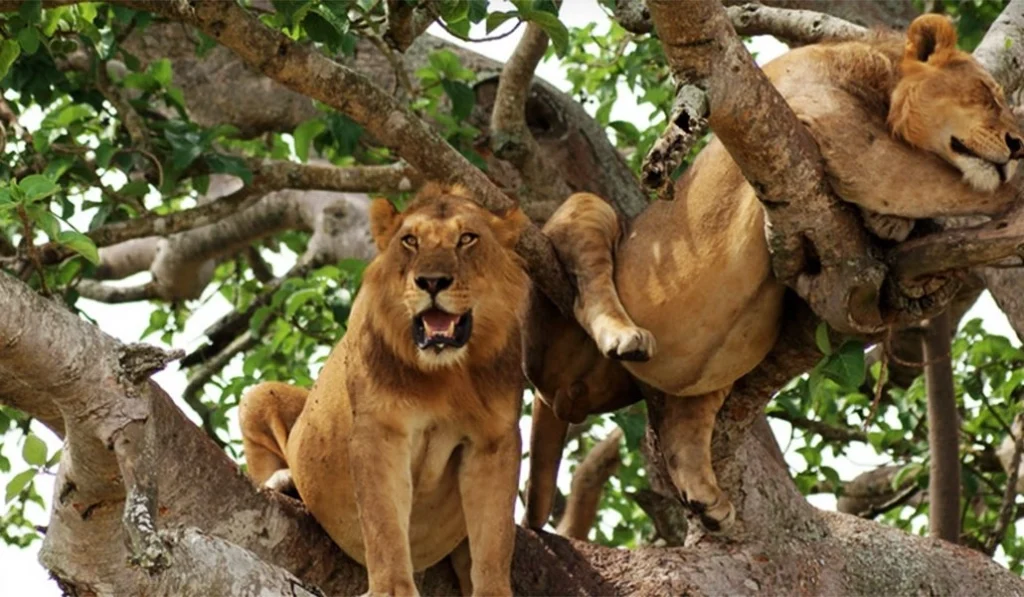
Stretching across nearly 2,000 square kilometres of western Uganda, where the Albertine Rift Valley dips between the Rwenzori Mountains and the shores of Lake Edward, Queen Elizabeth National Park is Uganda’s most visited and most ecologically diverse wildlife destination. It is the kind of park that rewards every type of traveller — the serious wildlife photographer, the first-time safari-goer, the avid birder, the adventure seeker, the cultural explorer, and anyone who simply wants to sit somewhere spectacularly beautiful and watch Africa go about its day.
The park was originally established in 1952 as Kazinga National Park, before being renamed in 1954 to honour a visit by Queen Elizabeth II. Today it forms part of the greater Queen Elizabeth Biosphere Reserve, recognised by UNESCO for its outstanding ecological significance. It supports over 95 mammal species and more than 600 bird species across a mosaic of habitats — open savannah, tropical forest, papyrus wetland, crater lakes, and the shores of two of Uganda’s largest lakes.
What makes Queen Elizabeth National Park truly special, beyond its sheer biodiversity, is its variety. In a single well-planned day here, you can do a morning game drive on open savannah, spend the middle of the day on a boat cruise with hippos gliding past the hull, and end the afternoon tracking chimpanzees in a dramatic gorge. There is no other park in Uganda — and very few in all of East Africa — that delivers this range and density of experience within such a compact, manageable space.
Here at Kenlink Tours, Queen Elizabeth National Park is a cornerstone of most of our western Uganda safari itineraries. In this guide, we walk you through every major activity the park offers, what to expect from each one, and how to plan your visit.
1. Game Drives — The Safari Heartbeat
Game drives are the foundation of any Queen Elizabeth National Park safari, and the park’s varied landscapes mean that no two drives ever feel the same. The park is divided into several distinct sectors, each with its own wildlife community and atmosphere.
The Kasenyi Plains in the northern sector are the park’s premier open-savannah game viewing area. This is where you come for lions, leopards, large elephant herds, buffalo, Uganda kobs, waterbucks, and warthogs moving freely across wide, golden grasslands with the Rwenzori Mountains rising on the horizon. Kasenyi is particularly good for predator sightings — the open terrain makes it easier to spot cats both at rest and on the hunt, especially in the early morning hours.
The Mweya Peninsula, the park’s main tourism hub, sits on a dramatic headland where Lake Edward and Lake George converge at the Kazinga Channel. Game drives along the peninsula produce reliable sightings of elephants, baboons, warthogs, and monitor lizards, often within metres of lodge terraces and at remarkably close range.
The Ishasha Sector, in the park’s remote southern corner bordering the Democratic Republic of Congo, is home to the park’s most famous residents — the tree-climbing lions — and is covered in its own section below.
Game drives in Queen Elizabeth National Park are best conducted in the early morning, from around 6:30 to 10:30 AM, and again in the late afternoon from around 3:30 PM until dusk. Kenlink Tours provides all game drives in private 4WD safari vehicles with pop-up roofs, giving you 360-degree sightlines and the freedom to stop, wait, and photograph at your own pace.
2. Kazinga Channel Boat Safari — Uganda’s Greatest Water Experience
If there is a single activity in Queen Elizabeth National Park that consistently leaves visitors speechless, it is the Kazinga Channel boat safari.
The Kazinga Channel is a 40-kilometre natural waterway connecting Lake George to Lake Edward. It is also one of the most wildlife-dense corridors in all of Africa. The channel’s banks are lined with one of the highest concentrations of hippos anywhere in the world — hundreds of them, wallowing, grunting, and surfacing with complete indifference to passing boats. Enormous Nile crocodiles haul themselves onto sandbanks in the afternoon sun. Elephants and buffalos wade in to drink and bathe. African fish eagles and pied kingfishers hunt from overhanging branches while pink-backed pelicans drift in formation overhead.
The standard Kazinga Channel boat cruise lasts approximately two hours and departs from the Mweya jetty. It is an entirely different experience from a land-based game drive — you are at water level, close to the animals, moving silently, with a wide-angle view of the banks on both sides. The boat’s gentle pace makes it ideal for photography, and the sheer density and variety of wildlife you encounter within a short distance is consistently extraordinary.
For birdwatchers, the channel is particularly exceptional — over 100 bird species can be realistically seen on a single cruise, including the African skimmer, great white pelican, goliath heron, malachite kingfisher, and African jacana.
The Kazinga Channel boat safari costs approximately USD $30 per person and is operated by Uganda Wildlife Authority. Kenlink Tours includes this activity as standard in all Queen Elizabeth National Park itineraries.
3. Tree-Climbing Lions of Ishasha — A Global Wildlife Rarity
One of Queen Elizabeth National Park’s most remarkable and unusual wildlife phenomena is found not in the main park area but in the Ishasha Sector — a remote, wild stretch of savannah in the park’s far south that most visitors have to make a deliberate effort to reach, and that most visitors say was entirely worth that effort.
The lions of Ishasha have developed a behaviour that is extraordinarily rare among lion populations worldwide: they regularly climb and rest in the broad branches of ancient fig trees, often lying draped across limbs several metres above the ground, watching the plains below with a relaxed, faintly regal air.
This behaviour has been documented in only a handful of lion populations in the world — Ishasha and the Maasai Mara in Kenya are the two most famous. No one is entirely certain why the Ishasha lions climb — theories range from shade-seeking to fly avoidance to simply learned tradition passed down through generations of the same prides — but the sight of a fully grown lion resting in a tree against a backdrop of open Uganda savannah is genuinely unforgettable.
Game drives in Ishasha focus on the Uganda fig and wild sycamore trees, particularly around the Ishasha River and the Ntungwe River floodplains. Buffalo, topi, Uganda kob, and elephant are also commonly seen across Ishasha’s grasslands.
Reaching Ishasha requires an additional two to three hours of driving from the main park area around Mweya, but many of Kenlink Tours’ itineraries build in an Ishasha overnight so that guests can spend a full morning here before continuing south towards Bwindi for gorilla trekking. See our Best Route to Bwindi from Queen Elizabeth National Park guide for more on how to combine these two parks.
4. Chimpanzee Trekking — Kyambura Gorge and Kalinzu Forest
Queen Elizabeth National Park is one of the very few places in the world where you can combine classic savannah big-game viewing with primate trekking on the same visit. The park offers two excellent chimpanzee trekking locations, each with its own distinct character.
Kyambura Gorge — locally called the Valley of Apes — is without doubt one of the most dramatic settings for chimpanzee trekking anywhere in Africa. The gorge is a steep, forest-lined canyon approximately 100 metres deep, carved by the Kyambura River into the surrounding open savannah floor. Descending into the gorge, you pass in moments from open, sunlit grassland into deep, humid forest — a transition so sudden and complete it feels almost theatrical.
A habituated chimpanzee community lives in the gorge, and trekking to find them — scrambling down into the canyon with a ranger guide, following fresh knuckle-prints and listening for distant calls — is an intimate, immersive experience that feels very different from chimpanzee trekking in Kibale’s more open forest. The contrast of the dark gorge forest against the bright savannah visible at the rim above makes for extraordinary photography.
Kalinzu Forest Reserve, on the southern boundary of the park near Bushenyi, is a less-visited but equally rewarding chimpanzee trekking destination. It is one of Uganda’s most affordable chimp trekking options and offers a quieter, more off-the-beaten-path experience. Kalinzu also harbours red-tailed monkeys, black-and-white colobus, L’Hoest’s monkeys, and an excellent range of forest birds.
For guests who have already trekked chimps in Kibale Forest on the same itinerary, the Kyambura Gorge experience remains compelling precisely because the landscape is so dramatically different. See our full guide on Chimp Trekking in Kalinzu Forest Reserve and Kibale National Park for a detailed comparison.
5. Birdwatching — Over 600 Species in One Park
Queen Elizabeth National Park is one of Africa’s great birding destinations. With over 606 bird species recorded within its boundaries — a number that exceeds the total bird count of many entire European countries — it is consistently ranked among the top birdwatching sites on the continent by the African Bird Club and visiting ornithologists.
The park’s diverse habitats support correspondingly diverse bird communities. The Kazinga Channel hosts waterbirds in extraordinary density and variety. The Maramagambo Forest in the south shelters Albertine Rift endemics — species found nowhere else on Earth. The crater lake area supports flamingos, pelicans, and open-water specialists. The savannah sectors attract raptors, ground birds, and aerial hunters.
Key species to look for include:
- African fish eagle — the iconic call of the African wilderness, commonly seen along the Kazinga Channel
- Shoebill stork — one of Africa’s most sought-after birds, found in the papyrus swamps at the northern end of Lake George
- African skimmer — a stunning and elegant waterbird, present along the Kazinga Channel
- Martial eagle — the largest eagle in Africa, seen soaring over the Kasenyi Plains
- Great blue turaco — a spectacular and unmistakable forest bird, common in Maramagambo
- Pink-backed pelican — regular on the Kazinga Channel boat cruise
- Papyrus gonolek, papyrus canary, and white-winged warbler — papyrus-endemic species in the channel’s margins
Kenlink Tours can arrange dedicated birdwatching game drives and boat cruises with specialist birding guides for guests making birding a priority of their Queen Elizabeth visit. The park is excellent for birding year-round, but the green season — October to November and March to May — brings migratory species and breeding plumage that make it particularly rewarding for serious listers.
6. Crater Drive and Lake Katwe Salt Works
The northern section of Queen Elizabeth National Park is dotted with explosion craters — circular, steep-sided volcanic depressions formed thousands of years ago by violent hydrothermal explosions when rising magma came into contact with groundwater. Many of these craters now hold lakes, ranging from the brilliant turquoise of alkaline craters to the deep blue-green of freshwater ones.
The Crater Drive is a scenic loop road that passes several of the most striking craters, offering panoramic views across the Rift Valley floor, the Rwenzori Mountains, and the crater lake district. It is one of the park’s most photographically rewarding experiences and a wonderful contrast to the flat savannah game drives.
Within this crater area sits Lake Katwe — a saltwater volcanic crater lake that has been mined for rock salt by local communities for centuries. The Katwe Salt Works is a genuinely fascinating cultural and geological site. Salt miners work the lake’s edges using traditional techniques passed down through generations, harvesting the crystalline salt deposits that form on the lake’s shallow margins. A visit to Katwe provides an insight into the lives of the communities who have lived alongside and within Queen Elizabeth National Park for centuries, and who continue to depend on the park’s resources for their livelihoods.
7. Nature Walks and Guided Hiking
For travellers who want to experience the park’s landscapes and wildlife from ground level — at walking pace, with all five senses engaged — Queen Elizabeth National Park offers guided nature walks in several areas.
The Maramagambo Forest in the park’s southeastern sector is particularly rewarding for forest walks. This ancient rainforest — a fragment of the Congo Basin forest ecosystem — is home to forest primates, forest birds, and the famous bat caves, where thousands of Egyptian fruit bats roost in the darkness of underground caverns. The caves are also visited by non-venomous python snakes that have learned to catch bats — creating a genuinely dramatic and unusual wildlife spectacle.
Guided walks are also available on the Mweya Peninsula, along the Kazinga Channel banks, and in the Ishasha sector. All walks are conducted with armed Uganda Wildlife Authority ranger escorts, and the pace, direction, and focus can be tailored to your interests.
8. Lion Tracking with Researchers
Queen Elizabeth National Park offers a unique lion tracking experience run in partnership with wildlife research teams studying the park’s lion population. Using radio telemetry equipment, guests accompany researchers to locate and observe lions — including the famous tree-climbing prides — in real time, while learning about the research, the individuals within each pride, and the conservation challenges facing lion populations in the park.
This experience provides a depth of engagement with the park’s predators that goes well beyond a standard game drive sighting, and is particularly popular with guests who have a strong interest in wildlife conservation.
9. Cultural Community Visits
Queen Elizabeth National Park sits within a landscape that has been home to communities — the Basongora, Bakonjo, Bakiga, and Banyaruguru — for centuries. Uganda Wildlife Authority and Kenlink Tours facilitate genuine, respectful cultural encounters with these communities, including:
- Traditional dance and music performances
- Visits to community craft cooperatives and local markets
- Guided walks through villages and farmland with community members
- Learning about traditional salt mining practices at Lake Katwe
- Storytelling sessions with community elders
These cultural encounters add a human dimension to the Queen Elizabeth safari experience that many visitors find as moving as the wildlife encounters themselves. Thirty percent of all revenues generated through Kenlink Tours’ safari operations go directly to supporting local communities — including an ongoing project supporting over 294 orphans in the Kisoro District.
Practical Information for Visiting Queen Elizabeth National Park
Location: Western Uganda, approximately 400 km from Kampala — a six to seven-hour drive via Mbarara, or a 45-minute charter flight to Kasese airstrip.
Park Entrance Fees: USD $40 per person per day for foreign non-residents, set by Uganda Wildlife Authority. Fees are included in all Kenlink Tours safari packages.
Best Time to Visit: The dry seasons — June to September and December to February — offer the best game viewing and most comfortable conditions. However, the park is rewarding year-round. Green season brings lush scenery, excellent birding, and reduced lodge rates.
How Many Days: We recommend a minimum of two nights in Queen Elizabeth National Park to comfortably cover the Kazinga Channel boat cruise, a Kasenyi game drive, and the Ishasha sector. Three nights allows for the Kyambura Gorge chimpanzee trek as well.
Combining Parks: Queen Elizabeth pairs perfectly with Kibale Forest for chimpanzees, Bwindi Impenetrable Forest for gorillas, and Lake Bunyonyi for relaxation. Many of Kenlink Tours’ most popular itineraries combine all four.
For accommodation, explore our Top Luxury Lodges in Queen Elizabeth National Park guide for options at every level, from the iconic Mweya Safari Lodge to our highly rated Elephant Hab Lodge on the Kyambura Gorge.
Plan Your Queen Elizabeth National Park Safari with Kenlink Tours
Whether you are coming for the tree-climbing lions of Ishasha, the extraordinary boat cruise on the Kazinga Channel, the chimpanzees of Kyambura Gorge, or the 600 birds that fill this park’s skies and waterways — Queen Elizabeth National Park will exceed your expectations.
At Kenlink Tours, we have been designing Queen Elizabeth safaris for over 15 years. We know the park intimately, from the best time of day to drive Kasenyi for lions to where the shoebills are most reliably seen at the edge of the papyrus swamps. We handle every detail of your visit — permits, accommodation, game drives, boat cruises, and all transfers — so that your focus is entirely on experiencing one of East Africa’s great national parks.
Explore our Uganda Safaris page for full itinerary options, or browse our Big Five and Primate Safari in Uganda package for a safari that combines Queen Elizabeth with Kibale and Bwindi in a single journey.
📞 Phone / WhatsApp: +256 789 210067 ✉️ Email: info@kenlinktours.com | inquiries@kenlinktours.com
Kenlink Tours — Est. 2010. Licensed by Uganda Tourism Board. Your expert safari partner in Uganda and East Africa.