- EXPERT'S HELP
- +256789210067
- +256200955001
- info@kenlinktours.com


Complete guide to Queen Elizabeth National Park
May 20, 2026
Best places to see chimpanzees in Uganda
May 20, 2026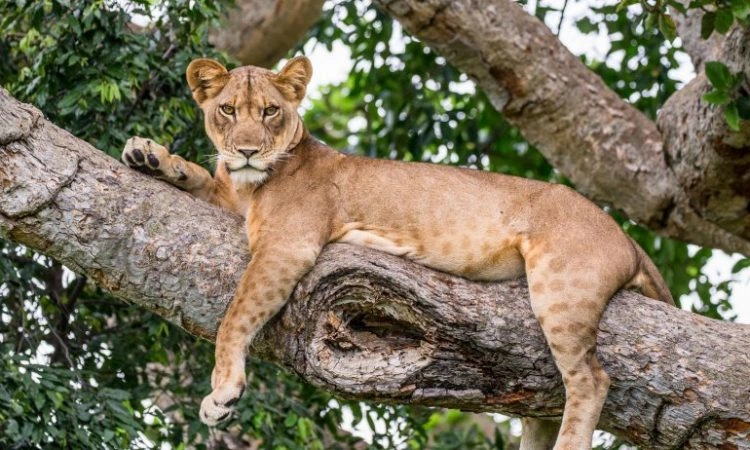
Tree-climbing lions of Ishasha: where and how to see them. Few wildlife experiences on the African continent are as rare, dramatic, and utterly unforgettable as watching a lion sprawled lazily across the high branches of an ancient fig tree, tail dangling, surveying its kingdom from above. This is not a scene from a nature documentary filmed in some remote corner of the world — it is a real, living spectacle waiting for you in the Ishasha sector of Queen Elizabeth National Park, in southwestern Uganda. If you are planning a Uganda safari and you have not added Ishasha to your itinerary, you are leaving out the most extraordinary chapter of the story.
What Makes the Ishasha Lions So Special?
Lions are not climbers by nature. Unlike leopards, which are instinctive tree-climbers who haul prey into the canopy to keep it safe from scavengers, lions are built for ground-level living. Their body mass, claw structure, and hunting strategy all point firmly downward. And yet, the lions of Ishasha do something their species-mates across Africa almost never do — they climb trees and stay there for hours, sometimes entire days.
This behavior has been documented and observed consistently in Ishasha for decades, making this small corner of Uganda one of only two places in the world where tree-climbing lions are reliably seen. The other location is Lake Manyara National Park in Tanzania, though sightings there have become increasingly inconsistent. That elevates Ishasha to a genuinely singular status on the global wildlife map.
The exact reason for the behavior remains a subject of lively scientific debate. The most widely accepted theory is that the lions climb to escape the relentless attention of biting flies and insects that thrive in the tall grass below, particularly during the hot midday hours. The breeze in the canopy offers relief. A second theory suggests the elevated vantage point gives the lions a broader view of grazing herds — particularly the enormous buffalo populations that roam Ishasha — allowing them to plan hunts with better intelligence. Most likely, the behavior began generations ago and has since been passed down as a learned cultural tradition within specific prides.
Whatever the origin, the result for the wildlife enthusiast is nothing short of breathtaking.
Where Exactly Is Ishasha?
Ishasha is the southern sector of Queen Elizabeth National Park, Uganda’s most celebrated savannah park. It lies in the far southwest of the country, near the border with the Democratic Republic of Congo, and shares the Albertine Rift ecosystem that makes this entire region one of Africa’s most biodiverse landscapes.
The Ishasha River meanders through the area, and it is along its banks and in the surrounding savannah that the giant fig trees and African ebony trees stand — the preferred climbing spots for the local lion prides. The landscape here feels wilder and less visited than the northern Kasenyi sector of Queen Elizabeth, which makes Ishasha feel like a true discovery even among experienced safari-goers.
Ishasha is approximately 480 kilometres from Kampala, a drive of roughly six to seven hours depending on road conditions. It is also conveniently positioned as a gateway between Bwindi Impenetrable Forest and Queen Elizabeth National Park, making it a natural addition to any gorilla trekking itinerary. Many travellers combine a gorilla trek in Bwindi with a lion search in Ishasha — arguably one of the most powerful wildlife double-headers on the planet.
The Best Time to See the Tree-Climbing Lions
Timing is everything on any safari, and Ishasha is no exception. The lions can technically be found in the trees during any month of the year, but certain conditions significantly improve your chances.
The dry seasons — June to August and December to February — are the best periods to visit. During these months, the grass is shorter, visibility is clearer, and the lions tend to spend more time resting in the trees during the heat of the day. Water sources concentrate wildlife, making animal sightings denser and more predictable.
The lions are most commonly spotted in the trees between mid-morning and mid-afternoon, typically from around 10 a.m. to 3 p.m., when the sun is at its highest and the ground-level heat is most intense. Early morning and late afternoon game drives are still rewarding — you may encounter the lions returning from a nocturnal hunt — but the classic canopy lounging shot is best captured in the midday warmth.
The long rains of March to May and the short rains of October and November can make roads muddy and the tall grass more challenging to navigate. Sightings are still possible, but the experience is harder. That said, the wet season brings the park to vivid green life, with newborn animals and spectacular birdlife, offering its own rewards.
According to the Uganda Wildlife Authority, Queen Elizabeth National Park — including the Ishasha sector — is home to one of Uganda’s largest lion populations, with populations carefully monitored as part of ongoing conservation efforts.
How to Plan Your Ishasha Safari
Getting There
Most visitors arrive in Ishasha by road from either Kampala (via Mbarara and Kabale) or Bwindi (a scenic two-hour drive through the highlands). The road from Bwindi to Ishasha passes through spectacular rural Uganda, with views of the Virunga volcanoes on clear days. A four-wheel-drive vehicle is strongly recommended, especially in the wet season.
Small charter flights are available to nearby airstrips, though the road journey is generally preferred for the scenic experience it provides.
Game Drives
All wildlife viewing in Ishasha is conducted by vehicle. Self-drive is permitted for visitors with appropriate documentation, but a guided game drive with an expert naturalist guide is strongly recommended — not just for safety, but because a trained eye will spot a lion tail hanging from a branch at 200 metres when you would see nothing but leaves.
Game drives typically last three to four hours. Morning and late afternoon drives are the standard structure, though a full-day drive with a packed lunch is an excellent option if you want to maximise your chances of the full lion-in-tree experience at midday.
Explore our Uganda safari packages to find the perfect itinerary that includes Ishasha, with expert guidance and seamless logistics built in from the moment you land in Entebbe.
Accommodation
Accommodation in and around Ishasha ranges from comfortable tented camps to mid-range lodges that offer an authentic bush atmosphere. Options include properties sitting right on the banks of the Ishasha River, where hippo calls and the sounds of the African night are your evening soundtrack. Staying overnight — rather than visiting as a day trip — dramatically increases your chances of seeing the lions and gives you access to both morning and afternoon drives.
What Else to See in Ishasha
While the tree-climbing lions are the undisputed headline act, Ishasha delivers a remarkably full wildlife experience in its own right. The sector is home to:
- Large buffalo herds — often numbering in the hundreds — which are the lions’ primary prey and a spectacular sight in themselves
- Uganda kob, the graceful antelope that appears on Uganda’s coat of arms
- African elephants, frequently seen crossing the floodplains near the river
- Hippos and Nile crocodiles in the Ishasha River
- An extraordinary diversity of birdlife, including the iconic African fish eagle, saddle-billed stork, and various kingfisher species
The Uganda Tourism Board consistently highlights Ishasha as one of the country’s must-visit wildlife destinations, and it is easy to see why — even without the lions, this is a world-class safari environment.
Combining Ishasha With a Broader Uganda Safari
One of the most compelling arguments for visiting Ishasha is how naturally it integrates into a broader Uganda safari circuit. Uganda is an extraordinarily compact country for its wildlife wealth, and Ishasha sits at the heart of a golden triangle of experiences:
- Bwindi Impenetrable Forest — for mountain gorilla trekking (a two to three hour drive from Ishasha)
- Queen Elizabeth National Park (Kasenyi sector) — for the famous Kazinga Channel boat cruise, chimpanzee tracking in Kyambura Gorge, and classic savannah game drives
- Lake Mburo National Park — for walking safaris and zebra sightings on the way back to Kampala
A well-structured seven to ten day itinerary can comfortably incorporate all of these experiences. Our team at Kenlink Tours has designed dozens of custom itineraries that weave Ishasha into a seamless, unforgettable journey.
Why Ishasha Should Be on Your List
There are wildlife experiences that are merely wonderful, and then there are those that fundamentally shift how you understand the natural world. Watching a lion in a tree — an animal that by every biological logic should be on the ground — falls firmly into the second category. It is a reminder that nature is always more creative, more surprising, and more astonishing than any expectation we carry into the wild.
The tree-climbing lions of Ishasha are not a guaranteed sighting, as no wild animal ever is. But they are a consistent presence in a landscape that rewards patient, curious visitors with moments they will carry for a lifetime. Uganda is rising fast as one of Africa’s finest safari destinations, and Ishasha is one of the brightest jewels in its crown.
Come and look up. You may just find a lion looking back down at you.
You may like too: