- EXPERT'S HELP
- +256789210067
- +256200955001
- info@kenlinktours.com


Fly-in safari Uganda: which airstrips and lodges are connected?
May 15, 2026
Gorillas vs chimpanzees: which primate trek is worth it?
May 17, 2026
Internet and mobile data Connection in on Uganda Safari. Planning a safari to the Pearl of Africa? Before you pack your binoculars and hiking boots, take a few minutes to understand how internet and mobile data work in Uganda. Staying connected — even partially — can make your journey safer, smoother, and far more enjoyable.
Why Connectivity Matters on a Uganda Safari
Uganda is one of East Africa’s most rewarding safari destinations, home to mountain gorillas, tree-climbing lions, and over 1,000 bird species. But unlike travelling in a city, a Uganda safari often takes you deep into national parks and remote rainforests where digital convenience is not guaranteed.
Whether you need to share a once-in-a-lifetime gorilla sighting with family back home, navigate an unfamiliar road, or simply check your booking confirmations, having a plan for mobile data before you land will save you a lot of stress. If you are still planning your itinerary, explore our range of Uganda Safari Packages or read our detailed About Uganda guide to understand the country’s landscapes and logistics before you go.
Uganda’s Mobile Network Landscape
Uganda has a relatively advanced mobile telecommunications sector for East Africa, overseen by the Uganda Communications Commission (UCC), the government body responsible for licensing and regulating all telecom operators in the country.
The two dominant networks you need to know as a traveller are:
MTN Uganda is the market leader, holding roughly half of all mobile subscribers in the country. It offers the widest coverage footprint, including strong 4G/LTE signals in Kampala, Entebbe, Jinja, and Mbarara, as well as reasonable 3G penetration along major highways and in areas surrounding key national parks. MTN is particularly well-suited for travellers who plan to move between multiple destinations and need reliable connectivity throughout the trip.
Airtel Uganda is the second-largest provider and a fierce competitor. It covers most urban centres and tourist corridors with solid 3G and 4G service. Airtel is especially attractive to budget-conscious travellers because of its competitively priced data bundles and flexible short-term prepaid packages. By 2019, Airtel had upgraded its entire network of over 1,600 base stations to 4G/LTE technology, making it a dependable option across a surprisingly wide area.
Both networks have kiosks at Entebbe International Airport, usually open until late evening, making it easy to get connected the moment you land.
What to Expect in Cities and Towns
In Kampala, Entebbe, Jinja, and Gulu, you can expect near-100% 4G coverage with speeds regularly reaching 30–50 Mbps on good days. Streaming, video calls, and map navigation all work comfortably in these areas. Hotel and restaurant Wi-Fi is widely available in urban centres, though speeds vary.
Most shopping malls, cafés, and guesthouses in larger towns offer free Wi-Fi, but these connections are often shared and can be slow during peak hours. For anything beyond light browsing, relying on your own mobile data bundle is the smarter choice.
Connectivity in Uganda’s National Parks
Here is where expectations need to be realistic. Uganda’s most iconic experiences — gorilla trekking in Bwindi Impenetrable Forest, chimp tracking in Kibale, game drives in Queen Elizabeth National Park, and boat safaris at Murchison Falls — all take you into areas where mobile coverage becomes patchy or disappears entirely.
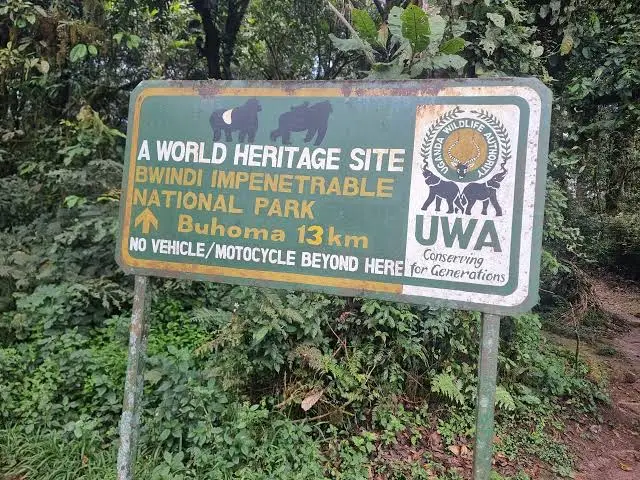
Bwindi Impenetrable Forest has limited connectivity inside the forest itself. At lodge locations in sectors like Buhoma and Rushaga, you may get occasional 2G or weak 3G signal, enough for messaging apps with some patience. If you are booking one of our Uganda Luxury Safari packages that includes premium lodges, many of these lodges provide satellite-backed Wi-Fi for guests, though speeds are typically modest.
Queen Elizabeth National Park and the Kazinga Channel area tend to have better signal than Bwindi, with MTN offering usable 3G in places like Mweya Peninsula. Coverage improves near the park entrance areas and main lodges.
Murchison Falls National Park is Uganda’s largest park, and connectivity reflects its size and remoteness. Major lodges close to the falls receive occasional data signals, but deep game-drive routes and the Nile delta area are largely offline. Download your offline maps before you go.
Kidepo Valley National Park, up in the far northeast, is the most remote of Uganda’s major parks. Expect very limited connectivity throughout your time there — which, honestly, only adds to the unspoiled, wilderness feel.
For trekking adventures, our Uganda Trekking Safaris page outlines what to expect physically and logistically in Uganda’s more rugged terrain, including the Rwenzori Mountains where mobile signals are essentially non-existent above certain altitudes.
How to Buy a SIM Card in Uganda
Purchasing a local SIM is straightforward and highly recommended over international roaming, which remains expensive on most foreign plans.
What you need: A valid passport. SIM registration is mandatory under Ugandan law. The vendor will photograph your passport, record your details, and activate the SIM on the spot.
Where to buy: Both MTN and Airtel have staffed booths at Entebbe International Airport in the arrivals hall. You can also find SIM cards at any official network store, supermarket, or roadside kiosk across the country. The initial SIM card costs around UGX 2,000–5,000 (approximately USD 0.50–1.30).
Data bundles: Once your SIM is active, load it with a data bundle rather than paying the default per-kilobyte rate, which is expensive. Both MTN and Airtel offer daily, weekly, and monthly bundles through their USSD menus (*150# for MTN, *175# for Airtel) or via their mobile apps. A weekly bundle of around 5–10 GB typically costs the equivalent of USD 3–8, depending on the package and promotion.
Tip: Make sure your phone is unlocked before you travel. Locked phones tied to a home-country carrier cannot use a Ugandan SIM.
eSIMs: A Growing Option for Travellers
If you prefer not to swap physical SIM cards, eSIM technology is a convenient alternative. Several international eSIM providers now offer Uganda data plans that you can activate before departure. Uganda’s main networks, including MTN and Airtel, power most eSIM roaming plans available in the country.
The advantage is simplicity: no physical SIM, no registration queue at the airport. The trade-off is that eSIM plans can be pricier than buying a local SIM directly, and coverage reliability can vary by provider. For most safari travellers making a single trip to Uganda, a local physical SIM remains the most cost-effective and reliable choice.
Practical Tips for Staying Connected on Safari
Getting the most out of Uganda’s mobile data landscape comes down to a few smart habits:
Download before you go. Save Google Maps offline for the areas you are visiting — Bwindi, Queen Elizabeth, Murchison Falls — before you leave your hotel in Kampala. This is genuinely invaluable when you are navigating dirt tracks in a national park with no signal.
Carry a power bank. Safari game drives are long, charging points in remote lodges can be limited, and the last thing you want is a dead phone when a leopard appears. A high-capacity power bank (10,000–20,000 mAh) is essential kit.
Use a MiFi device for heavy users. If you are a remote worker or part of a group that needs shared connectivity, consider renting or purchasing a portable MiFi router and loading it with a large data bundle. This lets multiple devices share one connection economically.
Lean on lodge Wi-Fi for bandwidth-heavy tasks. Upload photos, back up files, and make video calls from your lodge’s Wi-Fi rather than burning through your mobile data allowance in the field.
WhatsApp works well on limited data. The app compresses images and voice messages efficiently. Even on a weak 2G signal, you can often send a text message or a low-resolution photo to let loved ones know you are safe.
Planning Your Uganda Safari with Kenlink Tours
Understanding connectivity is just one piece of pre-trip planning. When you book through Kenlink Tours, our team briefs you thoroughly on what to expect at every destination, including lodge facilities and where to manage your digital expectations. Whether you are considering a classic Uganda Safari Holiday or looking to combine parks across multiple countries, we handle the logistics so you can focus on the experience.
For a personalised itinerary and current permit availability, visit our Uganda Safari Bookings page or contact us directly. Our guides are on the ground every day and can give you the most up-to-date advice on connectivity at your specific lodges.
Uganda’s wildlife will take your breath away. With a little preparation, your mobile data plan will not hold you back from capturing and sharing every extraordinary moment.
For further information on Uganda’s telecommunications regulations, visit the Uganda Communications Commission official website. For general travel and tourism guidance, the Uganda Tourism Board maintains a comprehensive resource for international visitors.
Related Reads:
- About Uganda – The Pearl of Africa
- Uganda Safari Holidays
- Uganda Luxury Safaris & Gorilla Tours
- Uganda Trekking Safaris
- Book Your Uganda Safari
- Does Uganda accept Credit Card Payments?
- Ranger Signals for Safe Gorilla Trekking
- Seeing Lions in Murchison Falls National Park
- Gorilla trekking briefing & guidance — Uganda and Rwanda
- Payment Options for Uganda Safaris and Tours